
Chapter 12
Tool 10:
Strategic global mindset
the keyhole model
Tool 10
Why: Developing a global mindset is relevant for companies that draw strategic benefit from it, so it makes sense to talk about a strategically rooted global mindset. The context around the individual company will then indicate what global mindset means in that company, and which groups of employees could usefully acquire it and to what extent. To link the development of global mindset and strategic performance together, global mindset needs to be tailored to the situation of the individual company rather than being treated as a ”one size fits all” solution, which everyone is expected to develop in the same way with the same result.
What: This tool describes the steps in a global mindset design process which uses the keyhole model of a strategic global mindset to help to identify the business case for global mindset in the context in which the user sits, and any specific opportunities and challenges associated with this. It therefore constitutes a roadmap for a process that results in a detailed description of the behaviour associated with displaying global mindset in a specific context. Challenges and opportunities can be summarized in a global mindset ”force field”.
Who: Use the model in leadership groups, departments and teams to discuss why and how global mindset adds value in your particular situation (Nielsen and Nielsen, 2016).
”Don’t go for 10 percent global mindset – go for just enough!”
(Three Things To Do, group 10, 2013)
The reason for taking a strategic look at global mindset is to capture and analyse the strategic potential in having a global mindset in the company. Not all global companies necessarily need the same global mindset or to have it to the same extent, nor should it be manifested in the same way in all companies. Global mindset can be characterized as follows ”a manager with a global mindset understands the need for global integration and local responsiveness and works to optimize this duality. The global mindset includes an appreciation for diversity as well as homogeneity and openness to learning from everywhere.” (Pucik, 2006, p. 88).
However, this definition says nothing about how to strike a balance in practice between global integration and local customization – or whether all companies have the same point of equilibrium. Nor does it say anything about how to reconcile standardization and diversity in the real world – or how openness to new ideas should manifest itself in the individual leader.
The assumption is therefore:
This means that there is no direct connection between a particular way of having a global mindset, a particular type of global mindset and a guarantee of business performance. In practice, every company working on its strategic global mindset therefore needs to explore and identify the special ”key” which can open the door for them to the performance potential in the specific context and situation in which they operate. This also means looking out for how the global mindset can have a beneficial effect on the execution of the company’s strategy, who it could benefit and how, and with what results.
The strategic global mindset model, also known as the ”keyhole model”, is based on the idea that context means something and makes a real difference to the way the individual company configures the global mindset in the organization and in the individual leaders and employees. In this context, the word ”strategic” refers to the idea that the company’s strategic goals are reflected in the leadership behaviour, which is then seen as a catalyst for achieving the business objectives and the desired performance.
In so far as the global mindset is linked to the business strategy, it can act as a driver for performance. However, this requires global mindset skills at both the individual and the organizational level in the company, as illustrated in the model:
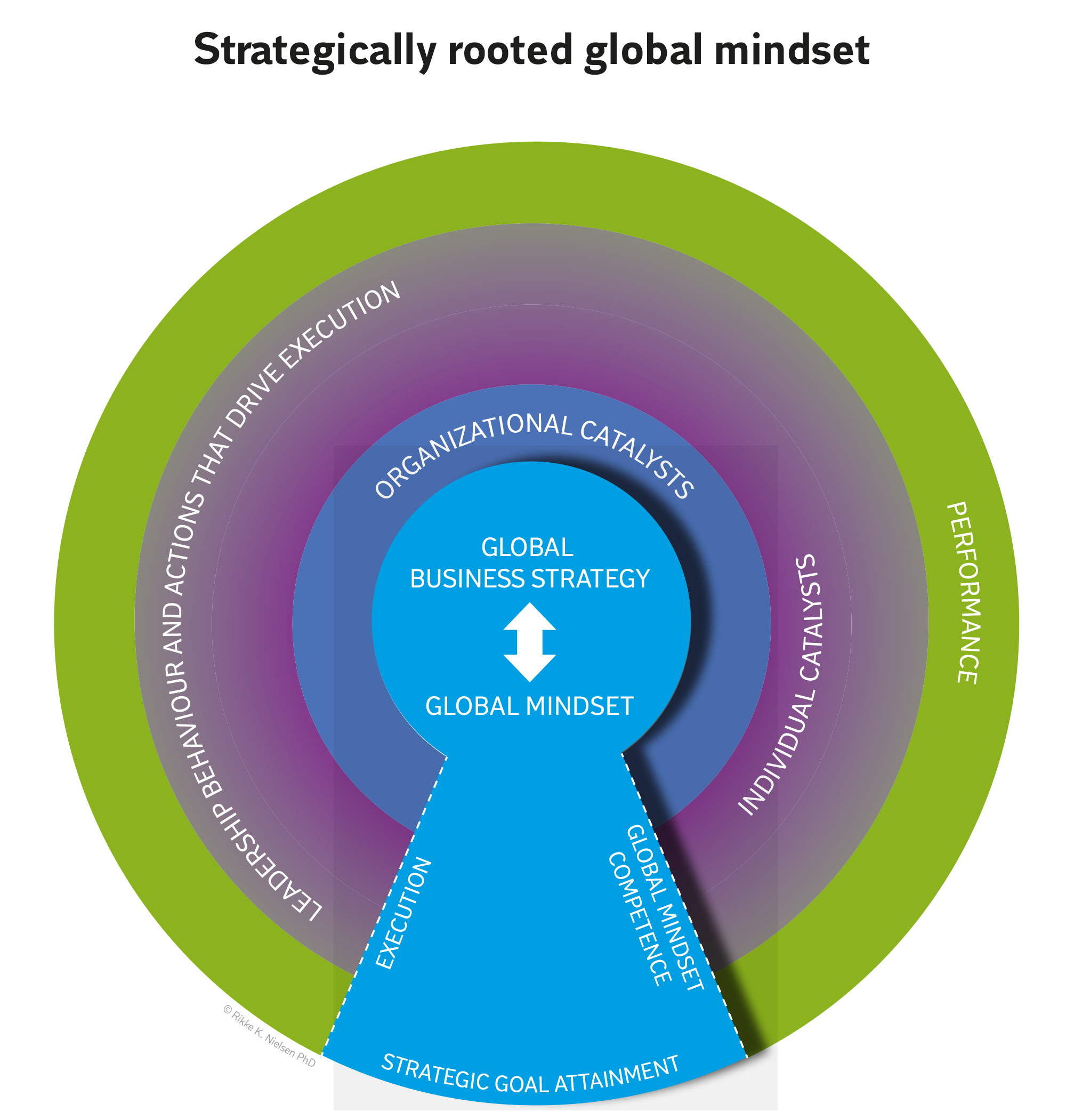
Figure 10.1: The keyhole model – strategically rooted global mindset (Nielsen, 2014)
The heart of the figure is the company’s global business strategy, which determines where and how it needs leadership with a global mindset. To support compliance with the strategy, there is a layer of organizational levers, called catalysts, which are meant to enable and allow globally motivated and competent individuals to execute the strategy. Individual catalysts are the global mindset skills that the individual leader needs to possess in order to execute the strategy; these are in the next ring. The specific types of action and behaviour assumed to promote execution in the individual company are shown in the second-to-last ring. On the outside is performance, which should be understood here to mean execution of the strategy as intended. The light blue keyhole that runs through the rings from the middle to the edge symbolizes the ability to unlock the potential that lies in the global mindset as a means of achieving this end. The point is that the development of global mindset competence at the organizational and the individual level enhances the execution of the global strategy and with it the company’s performance.
The keyhole model can be used by leaders and leadership groups to analyse how the development of a global mindset is linked to the company’s overall performance via their own targets. This is to determine how global mindset can be displayed in a way that is beneficial to execution of the strategy. This analysis is carried out to arrive at global mindset behaviour calculated to create utility value for:
Work on defining global mindset utility value and the associated behaviour starts in the middle of the figure and works outwards to the periphery by the following process:
1) Centre of the model: Your global mindset business case
The centre of the figure is the company’s global business strategy, which determines where and how it needs leadership with a global mindset. There is thus a direct connection between the company’s global strategy and the global mindset and behaviour within the organization. It sounds obvious, but when companies express a wish to work on their global mindset, they are often unable to answer the question: Why? If the answer is global mindset, what is the question? Work on global mindset therefore has to start by determining how working (together) globally adds strategic value. This means answering the following questions in relation to your role/function/team:
In this phase it may be helpful to draw inspiration from other companies’ work on global mindset, from research or from the company’s customers (perhaps by inviting them to a team meeting to give a short presentation of their experiences), as a way of kicking off the debate.
2) and 3) Individual catalysts – organizational catalysts
To support the implementation of and adherence to the strategy, there is a level of organizational intervention which should enable those individuals who are motivated and capable of working globally to help to implement the company’s strategy. These organizational catalysts can be found in the blue ring which surrounds the core of the model, and they may include the facilitators who are needed to build up and develop an organizational global mindset and the organizational structure to support it. Ways of enabling individual competences to support the company’s strategy with a global mindset are in the next circle in the model. Depending on the specific business strategy, these may be attributes such as experience of distance leadership and language skills.
The individual and organizational catalysts can usefully be discussed together, as they are related. You start with those closest to your own work and role. If you are working with the model from a middle management or team perspective, you should start with the individual facilitators. If you are approaching it from a top management or leadership development perspective, you may prefer to start with the organizational facilitators.
In both cases, the aim is to determine the balance between global integration/homogeneity and local customization/diversity in the specific context and how knowledge and ideas can be captured and disseminated (see definition of global mindset above). In this connection you can use the following questions, which should all be answered in the light of your business case for global collaboration, as determined in the previous step:
4) Leadership behaviour and actions that drive execution
If global mindset is to have a positive effect on performance, the identified skills need to be translated into behaviour and actions which all arise out of the individual leader’s global mindset. The particular form of behaviour and action which is considered likely to enhance the implementation of the company’s strategy in any given case can be found in the second-to-last ring. In this part of the process we identify concrete actions through which global mindset is manifested, which can be discussed via the following questions:
5) Performance
Performance (producing results) is the outermost ring in the model. Here, ”performance” should be viewed in relation to implementing the company’s strategy, i.e. identifying the concrete behaviour and the specific results of this behaviour that might promote execution of the strategy.
6) The keyhole in the model – and your key
The light blue keyhole in the middle of the model symbolizes the ability to unlock the potential that lies in the global mindset in order to develop and enhance the company’s performance. Based on the five preceding steps, you can now determine which factors promote or inhibit global strategy execution with a global mindset. You could do this with the model below, where you use your organizational practice to develop your own global mindset analysis of drivers and barriers.
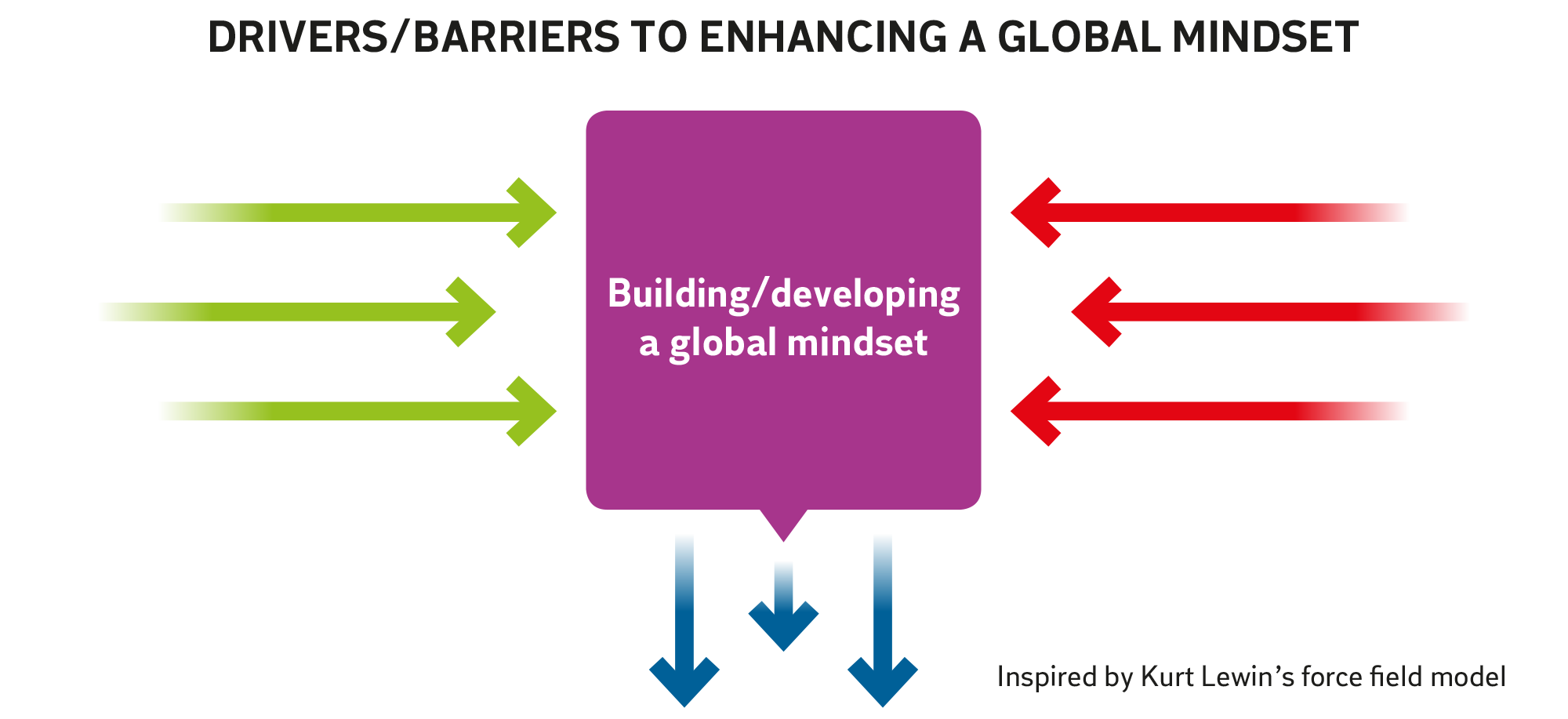
Figure 10.2: Global mindset force field
Analysis of drivers (promoters) and barriers (inhibitors):
Nielsen, R.K. (2014). ”Ledelse med globalt mindset – lederkompetencer i det globale”. In: F. Poulfelt (ed.), Børsens Ledelseshåndbøger, Strategi & Ledelse. Copenhagen: Børsens Forlag.
Nielsen, R.K. (2011). Kompetence-spotting i det globale ledelseslandskab: På udkig efter ”global mindset”. Ledelseidag.dk, No. 10, November, 2011.
Nielsen, R.K. (2014). Global Mindset as Managerial Meta-competence and Organizational Capability: Boundary-crossing Leadership Cooperation in the MNC. The Case of ”Group Mindset” in Solar A/S. Doctoral School of Organization and Management Studies, PhD Series; 24, 2014.
DEA think tank (2013). Three Things To Do. Tips and Tricks on How to Develop Global Mindset in 24 Months. An unedited summary of the results of a workshop conducted with those participating in the conference ”A Fast Track to Global mindset” organized by the DEA think tank, Managers and NOCA in Copenhagen on 17 April 2013.
Rosenfeldt, N. (ed.) (2013). The Ability to Execute Globally. A Fast Track to Global Mindset. Copenhagen: The DEA think tank.
Nielsen, R.K. & Bird, A. (Eds.) (Forthcoming). Connecting Individual and Organization Global Mindset in Theory and Practice. Frontiers in Global Management Series. Emerald Publishing Group. Nielsen, R.K. (2011). Discovering the blue ocean of global mindset. GLA Insights, March 3, 2011.
Nielsen, R.K. (2012). Mindset and leadership – group mindset in Solar A/S. GLA Insights. March 6, 2012, Rikke Kristine Nielsen.
Nielsen, R.K. (2010). Global mindset – succeskriterium ude og hjemme, Jyllands-Posten, November 3, 2010.
Toftkær, B. (2011). The need for a global mindset. GLA Insights, October 24, 2011.