
Chapter 4
Tool 2:
Your global mindset
– clarification tool
Tool 2
Why: One of the answers to the question of how a global leader should handle the growing complexity, ambiguity and uncertainty in a global leadership role is to develop a global mindset. But how do you do that? What function does the global mindset perform for the individual global leader and in what context? And how can it be developed other than through postings abroad?
What: This is a clarification tool which global leaders can make use of in developing a global mindset in their personal leadership. The tool presents three different perspectives on the development of a global mindset, defined as the ability to understand, address and balance the need for global integration with local adaptation based on global collaboration. Although you cannot be expected to design your own mindset, it is helpful to be able to target the effort at different areas of application and to be aware of sources for developing a global mindset in day-to-day work.
How and who: The tool can be used by global leaders, their leadership teams and sparring partners to determine how and where there is a need for a global mindset.
”We don’t see things as they are, we see them as we are”.
(Attributed to Anaïs Nin, The Seduction of the Minotaur, 2016).
Reality is in the eye of the beholder. A mindset can be seen as a filter through which we experience and make sense of the world in the manner of ”you are what you think”. Mindset is an attitude or way of thinking which results in a ”cognitive bias” – a kind of mental selective hearing which makes you prick up your ears in response to certain expressions while turning a deaf ear to others that are perceived as wrong or as just background noise. The word ”mindset” thus refers to an outlook, way of thinking or mentality which is crucial to the framework within which we experience the world and operate within it.
In relation to global leadership, a global mindset may then be seen as a special global mentality which pulls together what global leaders need to master in order to do their job: ”So there is no consistent way to point out what a global manager is. What we are left with is the search for good ’conventional’ managers with a global mindset…” (Baruch, 2002, p. 36).
There are various definitions of the ”global mindset” concept in use; the one we have found most helpful in the work of the Academy says of the global mindset that ”a manager with a global mindset understands the need for global integration and local responsiveness and works to optimize this duality. The global mindset includes an appreciation for diversity as well as homogeneity and openness to learning from everywhere.” (Pucik, 2006, p. 88). So we are talking about an ability to influence, develop and produce results together with other people who are fundamentally different from yourself.
This tool does not subscribe to the idea that there is one particular form of global mindset which is productive in all organizations and situations. It is also difficult to document from the research that any such relationship exists. (However, there are for example personality tests on the market which claim to reveal the degree to which individuals possess some kind of ”one size fits all” global mindset). We have found it more useful to regard the global mindset as a strategic global mindset, in the sense that the specific shape of the global mindset has to be linked to the strategy and objectives or the company, the department and the individual. So the practical work on the global mindset also has to be tied to the company’s strategy and the context in which it is to be used to bring results.
As a consequence of this, our aim with this tool is to clarify the situations in which a global mindset is needed, and how it can be developed under these conditions. There are three steps to this clarification process, which can ultimately be summarized in your personal global mindset development plan:
Step 1:
Global mindset – yourself and other people, your organization and other organizations
Step 2:
The global mindset mix: How much focus on the global, and how much on the local?
Step 3:
Development measures for a global mindset – where and how should you invest your resources?
”Now ’global’ has become a buzzword and everyone has to be global, but understanding why you are global, why you are travelling, why it is important to have sales and marketing people working close to an airport and close to where the skills are – all that is incredibly important to the process.” (Interview med global leader in connection with research project reported in Nielsen & Nielsen, 2016)
A first step towards clarifying global mindset development needs is to determine why it is necessary for the individual manager to develop a global mindset and in what situations it is needed. The model below outlines four different domains in which the global mindset comes into play:
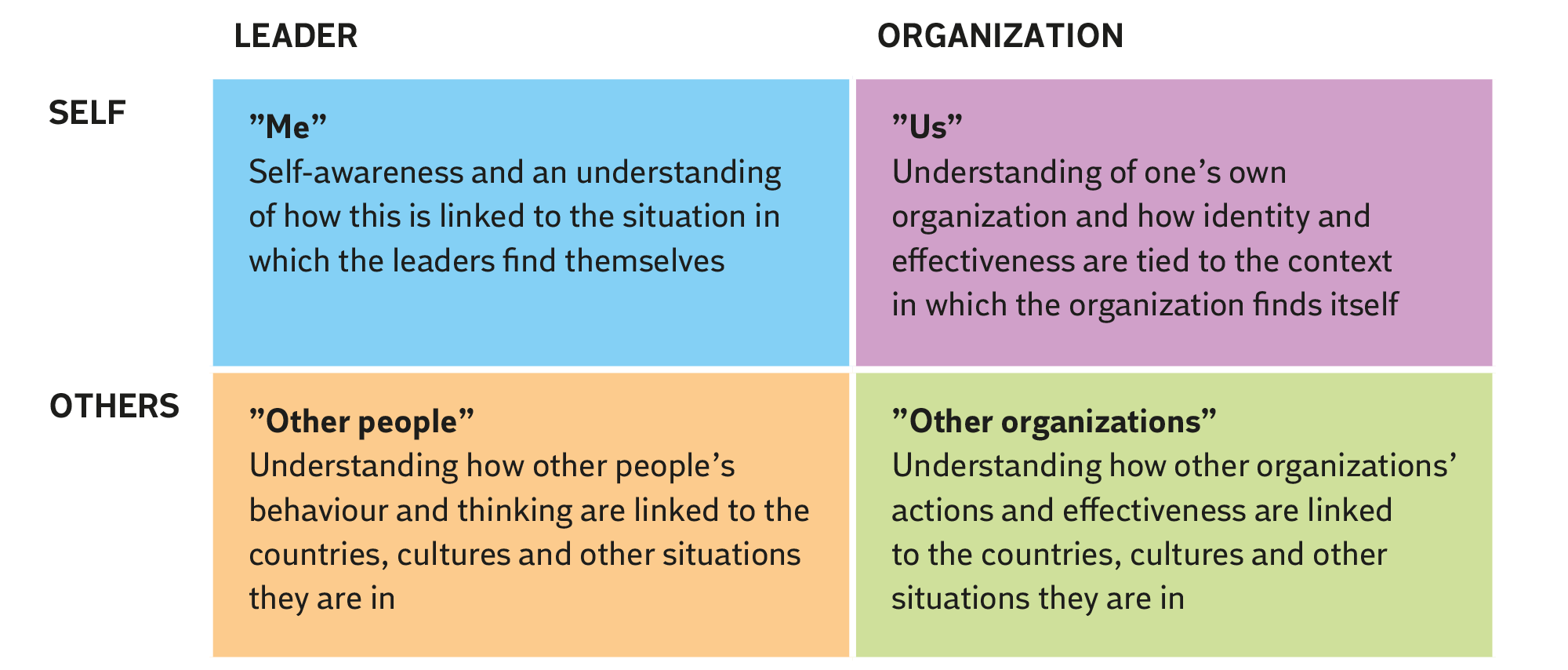
Figure 2.1: Global mindset – different applications (developed from Lane and Maznevski, 2014)
The first move in identifying global mindset development needs is therefore to assess the circumstances in which it needs to be applied. For example, do we understand our own familiar universe or ”others’ universe” that we want to zoom in on? These may be two sides of the same coin: for example, an awareness of how a position at HQ constrains your own actions (top left quadrant) may help you to understand how ”the others” in the subsidiaries act and perceive the world (bottom left quadrant). Similarly, a knowledge of your competitors’ and external partners’ business model (bottom right corner) may lead to a deeper understanding of the business model in your own organization (top right corner), and so on. You have to start somewhere:
”I think we need the different national types and also the holistic global types in management. We need both. Top-top-level should be the holistic, global guys – elsewhere in the organization you should maybe be a bit more local. In a management team some of the managers should have an anchorage in the local culture. The global mindset has to come in combination with local understanding.” (Global leader quoted in Storgaard & Skovgaard-Smith, 2012, p. 20).
The context in which the company needs to succeed and the specific job with its more or less global tasks are crucial to the mix of global and local that the individual leader needs to get on from day to day. You will recall our earlier definition of the global mindset, which emphasizes that a global mindset is not the same thing as standardization, harmonization and global integration, but allows scope to appreciate and prioritize both the global and the local. That means that there may be people in a management team with very different profiles in terms of how ”globally” they work and hence the mix of local and global that they need. The strength of the company lies in being aware of what the individual managers need, and how it can be developed/acquired, how the management team is made up and how well it is able to collaborate across the different roles and functions.
One of the research projects run in the Global Leadership Academy (Storgaard and Skovgaard-Smith, 2012) developed a simple model which can be used to generate discussion on the breakdown between globally and locally oriented thinking and behaviour in the individual manager and the team as a whole, outlining four different global mindset mixes which produce four different types of global mindset:
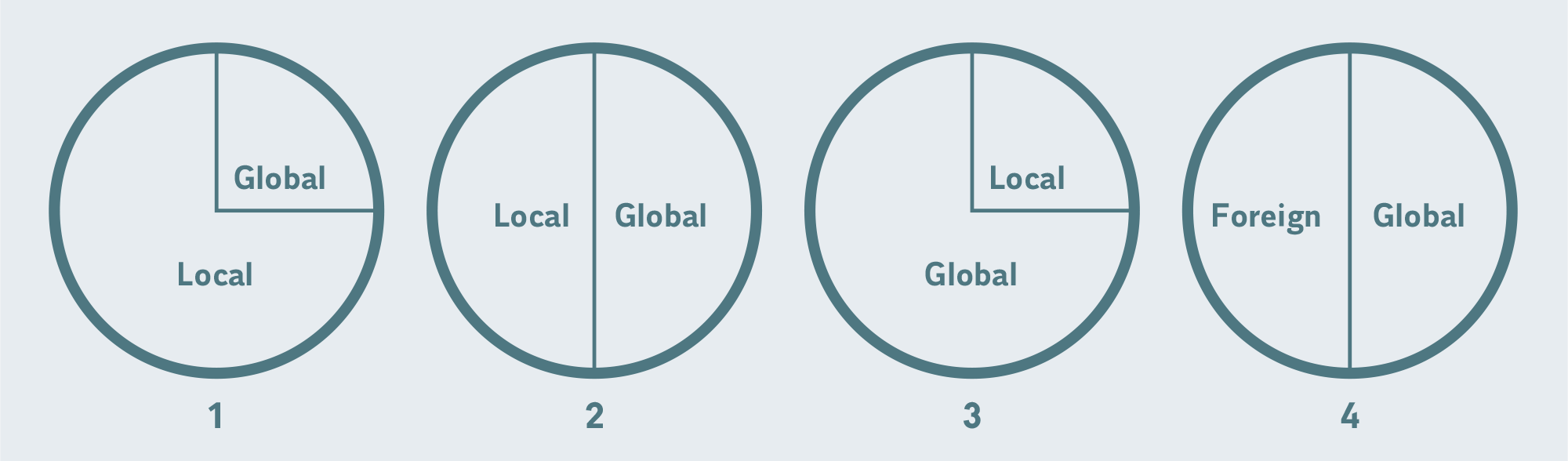
Figure 2.2: Global mindset mixes (Storgaard and Skovgaard-Smith, 2012)
Leaders who work in their own original local culture can in theory have a 100 percent local mindset, which is just as valuable as the other types of mindset on the assumption that the leader works 100 percent locally and never comes into contact with global activities or other leaders who operate globally. In the real word, however, there are very few leaders who do not have some form of global contact by virtue of market conditions and staff who come from other cultures etc.
It is helpful for individual leaders to be aware of their own mix of local/global mindset. The management team can then discuss how well the composition and proportions of local/global/foreign mindset, present in the management team as a whole match the needs of the company if it is to produce the expected results.
”I think that you can have various private and personal experiences that make you broaden your perspective. So, it is not necessarily the globetrotters we are looking for, but rather those who we think have a global mindset.” (Global leader quoted in Storgaard & Skovgaard-Smith, 2012, p. 14).
A global mindset can be developed in many different ways – not necessarily through global leadership development courses. Which should be prioritized first will depend on the context in which the global mindset is to be used (see step 1), and the mix of local and global that is considered appropriate for the job (see step 2). There follows a catalogue of possible areas for action, which can be called upon in different ways to develop a global mindset – and you will then be invited to assess your own readiness and possible development activities across the different areas:
On the principle that you yourself should embody the change that you want to see in the world, developing a global mindset has to start with an analysis of your own personality. In this connection, you can assess your readiness on three different fronts:
Personality and IQ cannot be influenced directly, but your understanding of these factors, and not least your active work on them, can be. Look at yourself in a new way – there may be character traits which are not seen as ”positive” in your own (national/cultural) background but which are viewed differently elsewhere, and vice versa. Some people incline towards authenticity – being true to yourself – and believe that the best thing you can do is to be who you are, for good or ill. Against this, one might say that, by definition, your authentic self is not the same thing as your best possible ”global leader self”. And if you always stick to being and doing what you have always been and done – being authentic – there will be no development, as learning may be seen as boundary-spanning activity where you displace yourself, moving out of your ”authentic” comfort zone and engaging in new ways of thinking which may become part of your ”authentic” repertoire over time. This idea is often expressed as ”fake it till you make it”, in the sense that, by experimenting with other types of behaviour, you become the person you are acting like and would like to be seen as.
”Being on an international assignment puts you in a position where you have to act – often without being 100 percent certain about what would be the right thing to do.”(Storgaard & Skovgaard-Smith, 2012, p. 29)
Global experience is often equated with visits or prolonged residence abroad, but although foreign postings can be a rich source of global experience, it is not the only one, and time spent abroad is not necessarily a benefit in itself.
We cannot all have dual nationality or be multilingual from childhood, but international experience helps – possibly. It very much depends on what you have made of your experience abroad. Research suggests that if there is no time for contemplation, feedback and reflection while building up overseas experience and after, you will not gain anything like the benefit that you might imagine. Tourist is not the same as cosmopolitan. Negative global experience can also have a negative impact on the development of a global mindset. So it is worth considering what you can do to turn negative experiences into personal development.
”Mobility itself is however sometimes more an idea, a mental state of mind, rather than actual, constant and never-ending physical mobility.” (Storgaard & Skovgaard-Smith, 2012, p. 57)
There is a lot of talk about how the internet and cookies target news feeds at us in such a way that we hear most about the things we are most in agreement with. In an interview on Danish TV on the occasion of her 100th birthday, Lise Nørgaard, Danish author and journalist, said that she took several newspapers, or differing political persuasions, including some she was downright opposed to, to keep herself alert. This principle can usefully be transferred to media and cultural consumption generally, if the aim is to develop a global mindset.
A Turkish saying claims that you are as many people as the number of languages you speak, and research also suggests that language skills are helpful in themselves to developing a global outlook, whatever their practical usefulness.
”You cannot learn this in five modules of a course. You have to be thrown into the experience and feel how you react. It need not be a different culture. You might also just be thrown into other job functions. As long as you are forced to move out of your comfort zone both professionally and managerially.”
(Global leader quoted in Storgaard & Skovgaard-Smith, 2012, p. 15).
The work of developing and maintaining a global mindset in the individual global leader can make use of this clarification tool below.
We recommend working at the following levels of assessment: very high, high, medium, low and very low. The form can be used by the leader and perhaps by someone who knows him/her and/or the job well.
It is also a good idea to enter a brief note explaining/expanding on the perceived need, so it is clear what it means in practice. This will make it much easier to continue with the process in terms of revealing the distance between the desired level and where you are now, and what development activities may be appropriate.
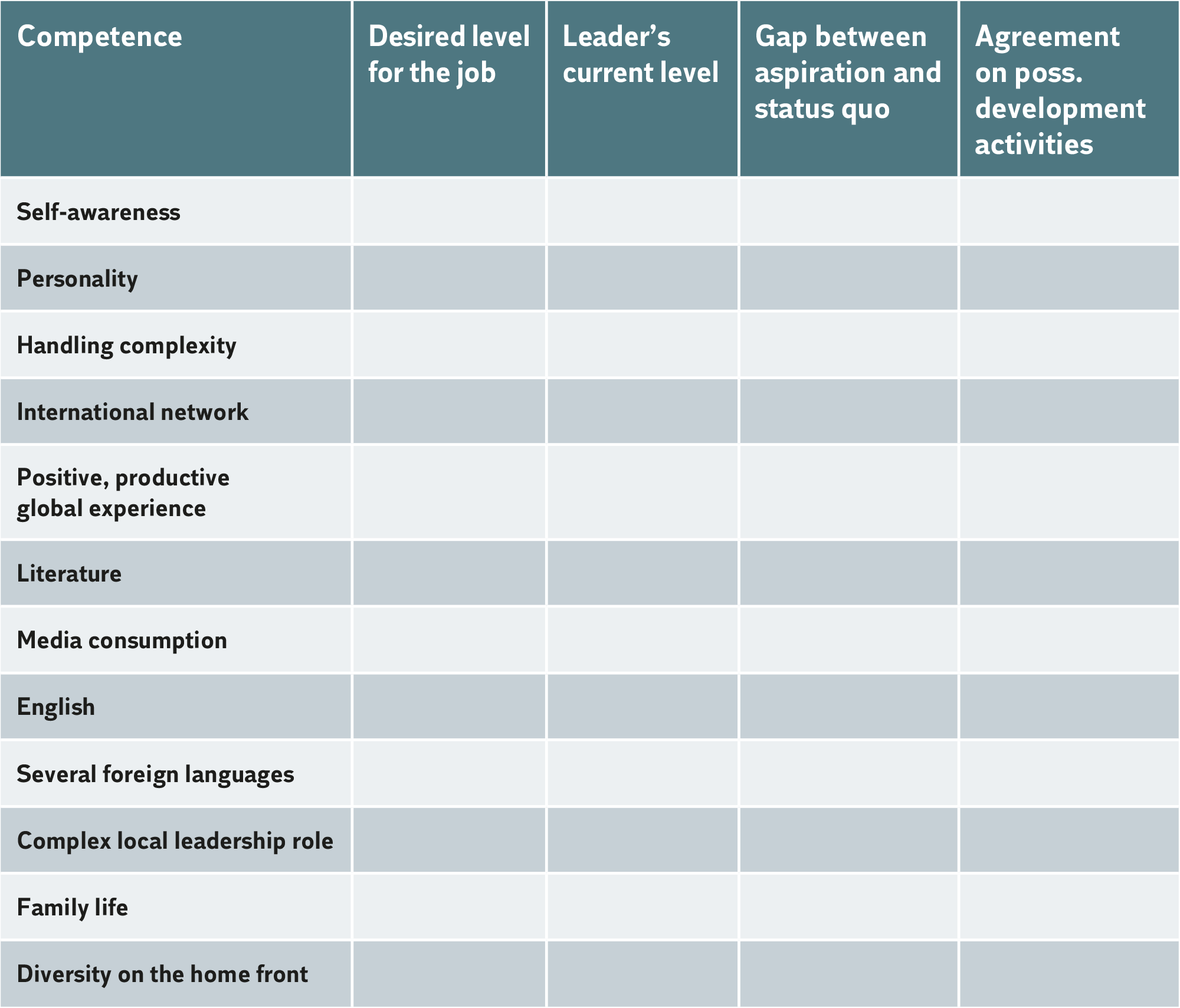
Figure 2.3: Developing a global mindset – areas for action, and development activities
Storgaard, M. & Skovgaard-Smith, I. (2012). Designing Organizations with a Global Mindset. København: Global Leadership Academy – Dansk Industri og Copenhagen Business School.
Nielsen, R.K. (2011). Discovering the blue ocean of global mindset. GLA Insights, March 3, 2011.
Nielsen, R.K. (2012). Mindset and leadership – group mindset in Solar A/S. GLA Insights. March 6, 2012.
Baruch, Y. (2002). No such thing as a global manager. Business Horizons, 45(1), 36-42.
Lane, H.W.; Maznevski, M. L.; DiStefano, J. J. & Dietz, J. (2009). International Management Behaviour. Leading with a Global Mindset. John Wiley & Sons, 6th edition.
Lane, H. W. & Maznevski, M. L. (2014). International Management Behaviour. Global and Sustainable Leadership, 7th Edition, Chichester, UK: John Wiley & Sons.
Nielsen, R.K. (2014). ”Ledelse med globalt mindset – lederkompetencer i det globale”. In: F. Poulfelt (ed.), Børsens Ledelseshåndbøger, Strategi & Ledelse. Copenhagen: Børsens Forlag.
Nielsen, R.K. (2011). Kompetence-spotting i det globale ledelseslandskab: På udkig efter ”global mindset”. Ledelseidag.dk, No. 10, November, 2011.
Nielsen, R.K. (2014). Global Mindset as Managerial Meta-competence and Organizational Capability: Boundary-crossing Leadership Cooperation in the MNC. The Case of ”Group Mindset” in Solar A/S. Doctoral School of Organization and Management Studies, PhD Series; 24, 2014.
Nielsen, R.K. (2010). Global mindset – succeskriterium ude og hjemme. Jyllands-Posten, November 3, 2010.
Toftkær, B. (2011). The need for a global mindset. GLA Insights, October 24, 2011.